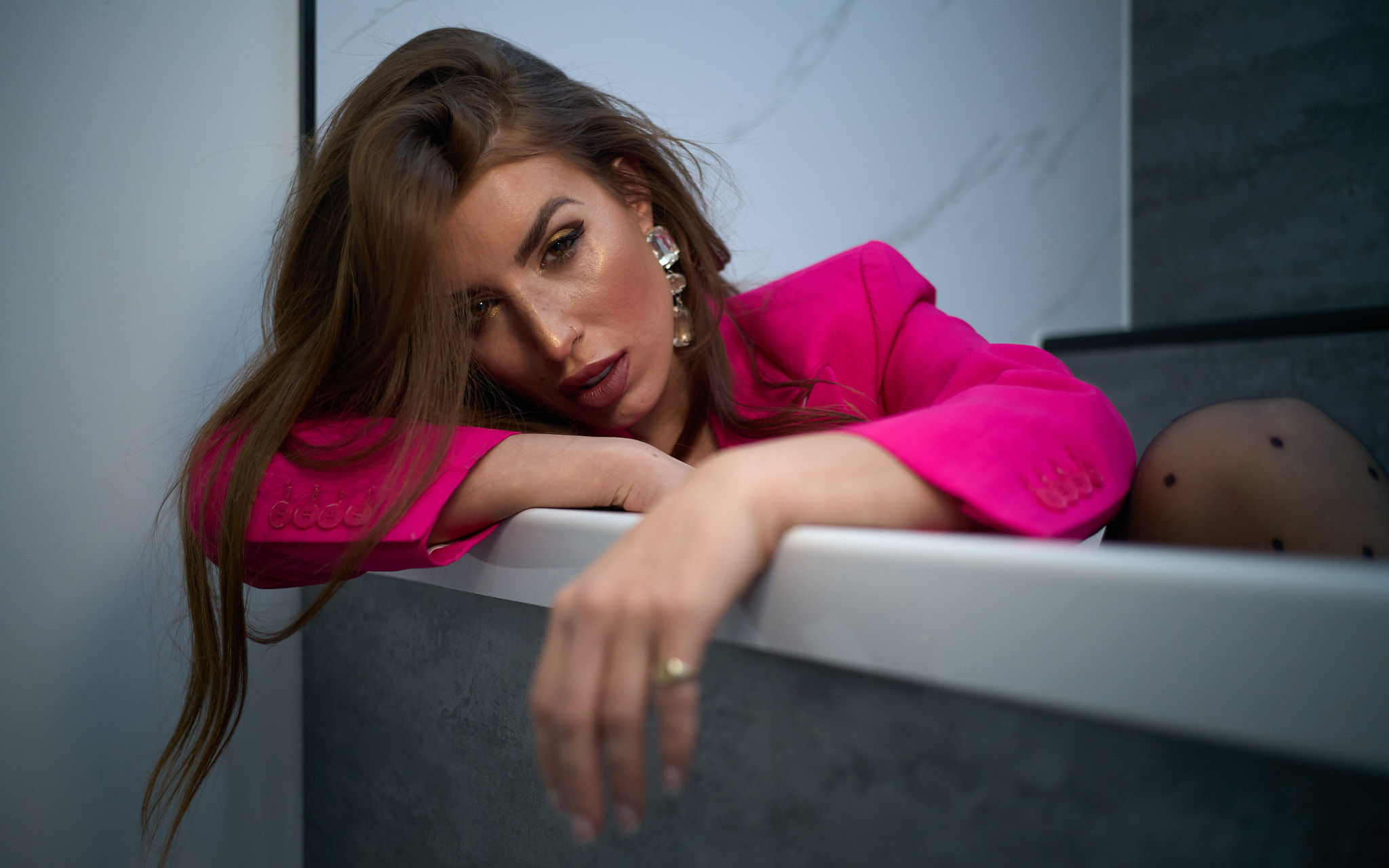
Fashion Meets Boudoir: Why I Ran Over Time on the Ella Rue Shoot
Sometimes you know you’re in the middle of something special. You’ve got decent light, the subject understands the camera, and everything’s clicking, literally and figuratively. That’s when you look at your watch, realise you’re twenty minutes past wrap, and decide to keep going anyway.
This is the story of shooting with Ella Rue, why I’d do it again in a heartbeat, and what happens when you prioritise the shot over the schedule.
Starting with the Right Person
Ella from the outset was reserved and confident; we’d never worked together before, so there’s always that initial formality. But within the thirty minutes, something shifted. She began to trust what I was doing with the camera, and that trust opened her up. By the time we were an hour in, she’d gone from measured to energised, offering ideas and willing to experiment.
We’d discussed the brief beforehand: an editorial-style shoot. Not lingerie, not straight portrait work, but something that lived in the space between intimacy and style. The kind of shoot where you’re exploring presence and confidence rather than just documenting an outfit.
The shoot was a collaborative effort from the outset. She wasn’t waiting for direction; she was offering it. Not in a “I know better than you” way, but in a “what if we tried this” way that actually made the work better. That’s the difference between someone who understands their own image and someone who thinks they do.
The Light, and How It Changed Everything
This was shot on a late afternoon in winter. That’s a very specific window of time. Winter light is low, warm, and honest. It doesn’t flatter. It reveals. You get maybe a few hours and then it starts to turn golden, then you lose it entirely.
I shot on a single small portable aperture LED video light imitating daylight, a Leica M11 Monochrome and an M-EV1. The plan was straightforward: editorial-style shoot, use what light we had, get solid images.
When I was checking beforehand, I noticed the mirrors everywhere. A vintage mirror, an assembled one, a broken mirror: the kind of collection that only accumulates over time. As I recently discovered a penchant for mirrors, immediately I thought: that could work. Not as the main focus, but as a visual element if the shoot went well enough.
We started exactly as discussed. Basic setup, different poses, different angles. Building rapport. Getting the foundation down. The light was good: that warm, low angle. I was shooting colour to start with but quickly swapped to monochrome because colour would’ve distracted from the actual presence in the frame.
How Mirrors Became the Shoot
About five minutes in, I decided to try using the mirrors. Not casually. I had a specific idea of how they might work with the light. Mirrors create layers. Reflections, depth, multiple angles of the same moment. Eventually it becomes pure geometry: the eye doesn’t know which Ella to look at, so it looks at all of them. The frame suddenly has more dimension.
We started using them intentionally. Different mirrors in different positions. Discovering angles I’d have never thought of on my own. And as I brought them in, Ella understood immediately what I was trying to do. She was energised by it. The shoot shifted from executed brief to creative exploration.
This was happening in the last couple of hours of decent light. The sun was dropping. At this point I asked Ella if she wanted to keep going, if there was time. She was up for it, so she headed off to swap outfits, and I stayed ready with the camera.
Once the natural light started to fade, I switched to the portable LED video light. That’s when the energy shifted again. We had light on our terms now, not the sun’s. She kept proposing different looks and poses, I was always trying to find new angles with the mirrors.
Toward the end of the shoot it was Ella who suggested absolute chaos for the final set. Chaos being something that appeals to my inner mess daemon. Dumping magazines on the bed, breaking every compositional rule we’d quietly followed. I suggested bringing in the broken mirror. Her partner joined in, making a smoke machine using nothing but patience and a vape pen, something we’d never planned for. None of it was choreographed. All of it worked.
That’s when we got the best frames. Not because the light was “better,” but because we’d stopped thinking and started playing. The natural deadline had passed. We were just discovering what happened when we let go.
Behind the Scenes: What Actually Happened
Let’s be honest: BTS photos make everything look more glamorous than it is.
What actually happened was me faffing about with different lenses, checking the light, making minor adjustments. Ella disappearing to change outfits, coming back, me figuring out what the mirrors were doing with the light that time. Repeat. There was a moment where we were trying to get a specific angle and I realised the only way to get it was to stand on a radiator. So I did. People were laughing at my general clumsiness. The resulting image is one of my favourites from the shoot.
We talked while she was between outfit changes - she was into editorial work, I was trying to explain why I care more about light than fashion. We probably bored each other slightly on our respective obsessions, then found common ground in “yeah but what if we tried this?”
The rhythm of the shoot was actually: she’d change, come back, we’d shoot, I’d see something that could work better, we’d adjust, and then repeat. By the time the sun dropped and I switched to the LED light, we’d already found our groove.
What Made This Shoot Work
Being comfortable in front of the camera is one thing. Understanding what you’re trying to achieve together is another.
What Ella had was something better: she understood her own image without being precious about it. She knew what worked for her, but she wasn’t defensive about trying something different. She was curious. She asked questions about why I was doing things a certain way, rather than just executing instructions.
That interaction and collaboration through questioning is golden. It comes from experience. It means you’re not just pointing and shooting; you’re problem-solving together. It means when an idea doesn’t work, you both know why and you move on. It means you can push further than you normally would because there’s genuine collaboration happening.
Also, and this matters: she showed up fully prepared, had outfits already picked out that actually worked with the brief, didn’t overthink things, and was willing to stay late because she could see we were onto something good.
The Leica Question
People always ask about gear. “What camera did you use?” As if that’s the variable that matters.
I used a Leica M11 Monochrome and an M-EV1 because I like the rangefinder workflow, because monochrome forces you to think differently, and because the image quality is genuinely good. But honestly? I could have shot this on a decent mirrorless camera and got similar results.
The camera isn’t what made this shoot work. The light was. The subject was. The decision to stay twenty minutes longer was. The willingness to try things that may seem a little unusual or out of the box was.
That said, the Leica forced a specific discipline. No autofocus hunting. No digital chimping endlessly. Just: compose, focus, shoot, move on. That rhythm actually works for this kind of shoot. It keeps you present rather than lost in post-production decisions in real-time.
Would I Do It Again?
Absolutely. Though I do owe Ella and her partner an apology for making them both late for dinner. But in my defence, we were getting great pictures.
By the final hour, we weren’t thinking straight anymore, in the best way: genuinely working together to make the best images we could.
That’s the moment where a shoot stops being about executing a brief and becomes about seeing what happens when you let go. When everyone in the room is willing to try something half-formed because you’re all curious about whether it’ll work.
If the light and the moment align, and everyone’s willing, I’m staying. That’s what separates competent from actually good: the willingness to push further when something’s working, even if it means keeping people past dinner time.
And the ability to work with people who trust you enough to say yes to absolute chaos.
Thank you Ella.